
Innovate. Connect. Expand.
Enterprise Mobile App Development for Powerful Business Transformation
Enterprise Mobile App Development helps organizations transform complex business operations into connected, efficient, and accessible digital experiences. We develop custom enterprise mobile applications that bring employees, customers, partners, and business systems together through intelligent functionality.
Modern organizations manage multiple departments, employees, customers, vendors, and operational systems simultaneously. When important activities depend on separate software, manual documentation, or desktop-only applications, information becomes difficult to access and business processes can slow down. Enterprise Mobile App Development creates a connected mobile environment where authorized users can perform essential activities, access business information, and communicate with connected systems from supported devices.
Enterprise applications also require careful planning beyond their visual interface. Different departments may need different permissions, certain activities may require approval, and some operations must continue when internet connectivity is unavailable.
Enterprise Mobile App Development
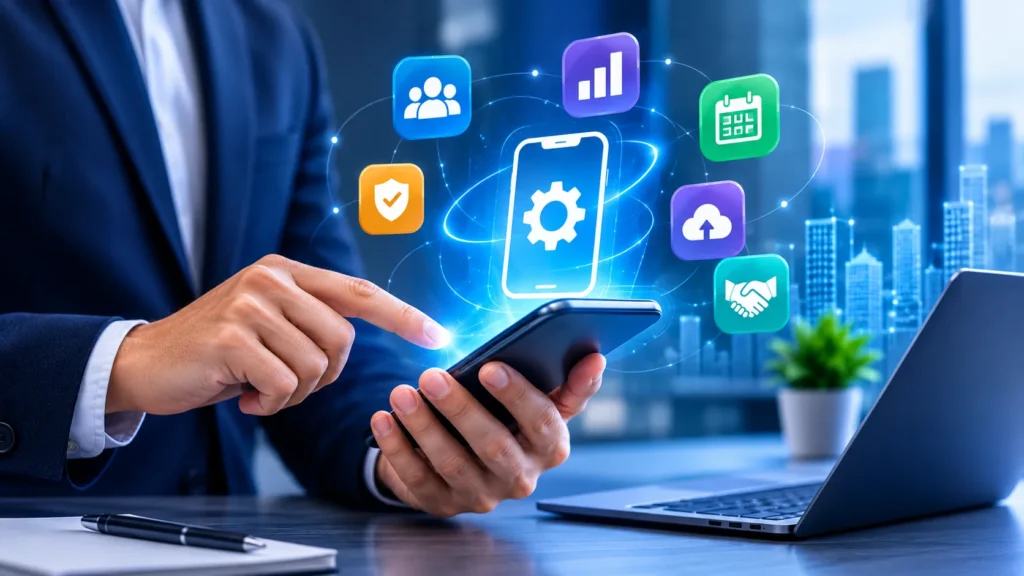
Access essential business information through a connected mobile application. Organize departmental activities, operational records, internal requests, and important updates within a structured environment designed around employee responsibilities.
Centralized Business Operations
Develop modules for employee profiles, attendance records, task allocation, leave requests, and approval workflows. Role-specific interfaces help teams manage workforce activities while providing managers with better operational visibility.
Employee and Workforce Management
Connect mobile applications with existing ERP, CRM, HRM, inventory, and accounting platforms through suitable APIs. Structured integrations help maintain consistent information and reduce repetitive data entry across business departments.
Enterprise System Integration
Implement authentication, role-based permissions, secure sessions, and protected communication channels. Different user groups receive access according to their responsibilities, helping organizations manage sensitive business information more carefully.
Secure Authentication and Access Control
Provide relevant operational updates, notifications, reporting summaries, and activity information through connected backend services. Timely information helps employees respond to changes and managers monitor important business activities.
Real-Time Business Information
Build applications for supported Android and iOS devices using suitable native or cross-platform technologies. Consistent navigation and responsive interfaces help employees and business users access essential functions across devices.
Cross-Platform Application Experience
Six Essential Capabilities of Enterprise Mobile App Development
Custom Enterprise Mobile App Development Built for Complex Business Requirements
Enterprise applications are different from ordinary mobile products because they often become part of an organization’s daily operating infrastructure. A manufacturing company may require production monitoring, inventory updates, quality inspection records, and equipment information. A logistics organization may need shipment tracking, delivery confirmation, fleet coordination, and location-based workflows. A healthcare business may require appointment coordination, staff access, patient-related workflows, and protected information handling. Each application needs an architecture that reflects its intended users, operational environment, and information requirements.
Our Enterprise Mobile App Development process starts with understanding your business objectives and identifying the problems the application should solve. We examine existing software, user responsibilities, data sources, required integrations, and expected application usage. Based on these findings, we plan the application structure, map important user journeys, define backend requirements, and select appropriate development technologies.
Advanced Features That Make Enterprise Mobile Applications More Effective
Automate repetitive operational tasks, approval requests, internal notifications, and status updates through configurable business rules. Structured workflows help reduce unnecessary manual coordination and improve process consistency.
Workflow Automation and Approval Management
Allow selected application activities to continue without continuous internet connectivity. Local data storage, queued updates, and synchronization rules help employees work in remote locations while managing conflicting changes appropriately.
Offline Functionality and Data Synchronization
Create customized reporting interfaces that display operational performance, departmental activity, workforce information, and selected business indicators. Relevant data views help managers evaluate processes and identify areas requiring attention.
Enterprise Analytics and Reporting
Connect applications with suitable cloud services, backend APIs, databases, and storage systems. A well-planned infrastructure supports centralized data management, controlled access, application monitoring, and future capacity improvements.
Cloud Connectivity and Backend Infrastructure
Deliver important operational alerts, task assignments, approval updates, and business announcements through suitable notification services. Notification preferences and permission controls help ensure that information reaches the appropriate users.
Push Notifications and Internal Communication
Design modular application components that can accommodate additional users, departments, services, and integrations. Maintainable backend architecture helps organizations introduce new functionality without unnecessarily rebuilding existing application modules.
Scalable Architecture and Third-Party Integrations
Frequently Asked Questions?
A regular mobile app may focus on individual consumer activities, while an enterprise application generally supports organizational workflows, multiple user roles, business integrations, and centralized administration. Enterprise solutions also require additional consideration for security, scalability, data management, and operational reliability.
Yes. Enterprise applications can integrate with compatible ERP, CRM, HRM, accounting, inventory, and other platforms through available APIs or integration services. The integration approach depends on the existing software architecture, authentication methods, data formats, and provider capabilities.
Yes. Applications can be developed for Android, iOS, or both platforms. Native technologies or cross-platform frameworks can be selected after evaluating device requirements, performance expectations, platform-specific functionality, and long-term maintenance considerations.
Let's Connect
Ready to Start Your Project?
Let’s discuss how we can help bring your vision to life with our expertise.