
Build. Connect. Expand.
Cloud-Based Business Software Development for Modern Companies
Cloud-Based Business Software Development enables businesses to manage operations, connect teams, access information, and automate important workflows through applications hosted in cloud environments.
Managing business operations through separate applications, spreadsheets, locally installed programs, and manual communication can create unnecessary complexity. Employees may work with outdated information, managers may struggle to monitor ongoing activities, and different departments may spend valuable time transferring data between systems. As businesses expand, these disconnected processes can become difficult to maintain. Cloud-Based Business Software Development provides an opportunity to bring essential business activities into centralized applications that authorized users can access through internet-connected devices.
Our development process considers both the application and the infrastructure behind it. We plan the user interface, backend functionality, database architecture, integration requirements, deployment environment, and ongoing maintenance needs.
Cloud-Based Business Software Development That Connects Your Entire Business
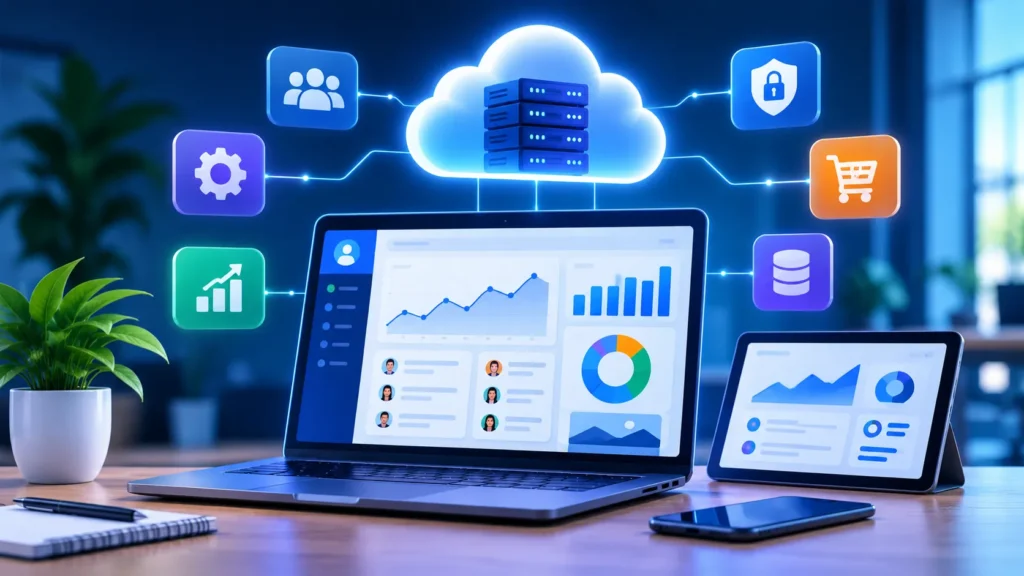
Manage essential business activities through one connected application. Organize departmental workflows, employee responsibilities, operational records, approvals, and business information while reducing unnecessary dependence on disconnected tools.
Centralized Business Process Management
Store and organize business information using suitable cloud databases and storage services. Implement authentication, permission controls, encryption, backup strategies, and data validation to support reliable information management.
Secure Cloud Data Management
Give authorized employees access to relevant applications through supported web browsers and devices. Shared information and coordinated workflows help teams collaborate across departments, offices, and remote working environments.
Real-Time Collaboration and Accessibility
Automate repetitive processes such as task assignments, notifications, approval requests, scheduled activities, and data updates. Configurable workflows help reduce manual coordination and improve consistency across daily operations.
Business Workflow Automation
Convert operational information into useful reports, dashboards, and performance indicators. Apply filters, date ranges, and role-specific views to help managers understand business activity and make informed decisions.
Custom Reporting and Business Analytics
Connect cloud applications with suitable CRM, ERP, accounting, payment, communication, and inventory platforms. API-based integrations help different systems exchange information while reducing duplicate data entry.
Flexible Application Integration
Six Essential Capabilities of Cloud-Based Business Software
Custom Cloud-Based Business Software Development Built for Your Workflow
Every organization has different operational requirements, and its software should reflect those differences. A retail business may need centralized inventory, purchasing, billing, and supplier management, while a service company may require customer records, employee scheduling, project tracking, and automated notifications. Manufacturing organizations may need production monitoring, resource planning, quality records, and inventory coordination. Building software around these specific workflows allows businesses to manage their activities without unnecessary features or complicated workarounds.
We also consider the infrastructure requirements before selecting a deployment strategy. Application workloads, database usage, file storage, network communication, backup policies, and expected user activity all influence the cloud architecture. Suitable managed services, containers, automated deployment pipelines, caching, and monitoring can be introduced where they provide practical value.

Advanced Cloud Software Features for Smarter Business Operations
Create separate access levels for administrators, employees, managers, customers, and other user groups. Configure permissions according to responsibilities while maintaining appropriate separation of sensitive business information.
Multi-User Access and Role Management
Manage operations across multiple offices, branches, departments, or business locations through a centralized platform. Location-based records and permissions help maintain visibility while supporting different operational responsibilities.
Multi-Branch and Multi-Location Management
Implement scheduled database backups, storage protection, and recovery procedures based on business continuity requirements. Regular recovery testing helps verify that important information can be restored when necessary.
Automated Backups and Data Recovery Planning
Connect business applications with external platforms through suitable APIs, webhooks, and integration services. Support data exchange between systems while accounting for authentication, failed requests, duplicate updates, and synchronization requirements.
Cloud API and Third-Party Integrations
Design applications to accommodate changing workloads through suitable hosting resources, caching, database optimization, and background processing. Infrastructure can be adjusted as user numbers, application activity, and data requirements increase.
Scalable Infrastructure and Performance Optimization
Develop cloud-based products with customer registration, subscription plans, account management, billing integration, and self-service dashboards. Multi-tenant architecture can support multiple organizations while maintaining appropriate data separation.
SaaS Subscription and Customer Portal Management
Frequently Asked Questions?
Cloud-Based Business Software Development is the process of designing and building business applications that operate using cloud infrastructure. These applications can help organizations manage employees, customers, inventory, projects, financial records, workflows, and reporting through internet-accessible software.
We develop custom cloud-based applications according to business requirements. Potential solutions include CRM software, ERP applications, employee management systems, inventory platforms, project management software, customer portals, booking applications, and SaaS products.
Businesses can use cloud-based software to centralize information, improve collaboration, automate repetitive processes, and connect different departments. Employees can access authorized application features from supported locations and devices without depending on a single office computer.
Let's Connect
Ready to Start Your Project?
Let’s discuss how we can help bring your vision to life with our expertise.