
Learn. Play. Evolve.
How AI-Powered Educational Games Are Transforming Digital Learning
AI-Powered Educational Game Development is changing how students interact with educational content by combining artificial intelligence, interactive gameplay, personalized challenges, and intelligent feedback. We develop innovative educational games that turn complex subjects into engaging digital experiences.
Traditional digital learning often relies on fixed lessons, repetitive exercises, and standardized assessments that may not address every learner’s needs. Students can progress through the same activities regardless of their understanding, learning speed, or individual difficulties. AI-Powered Educational Game Development introduces a more responsive approach by combining intelligent algorithms with interactive game mechanics. Instead of presenting identical challenges to everyone, an AI-enabled educational game can analyze gameplay responses, identify knowledge gaps, adjust challenge levels, and provide relevant learning assistance.
This creates opportunities for more personalized experiences where educational activities respond to how learners interact with the game. Concepts such as mathematics, science, language learning, programming, history, and problem-solving can be presented through missions, simulations, puzzles, virtual environments, and interactive challenges. The objective is not simply to make education entertaining but to connect gameplay decisions with meaningful learning outcomes.
AI-Powered Educational Game Development Is Redefining Interactive Learning
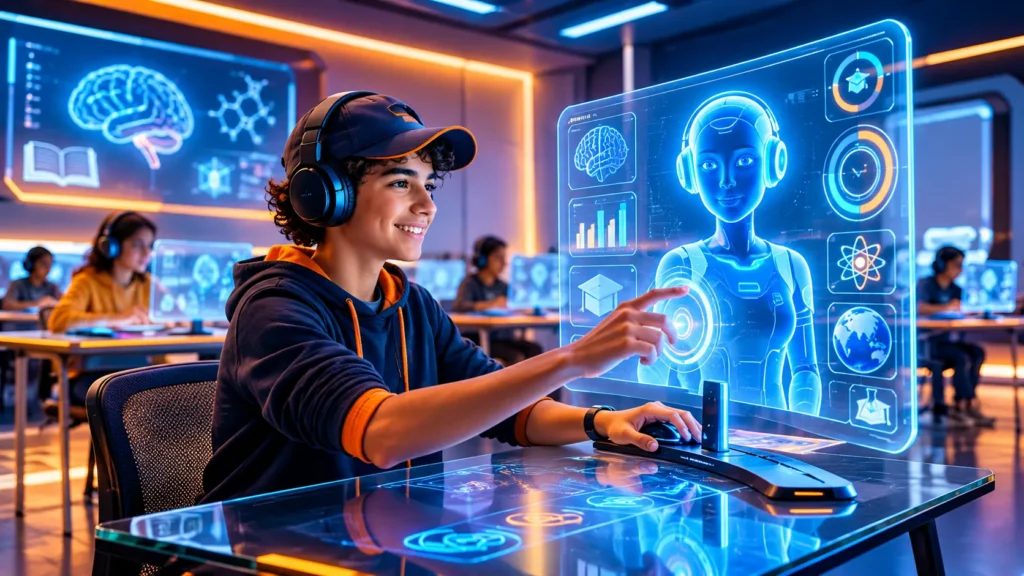
AI analyzes learner responses and gameplay performance to adjust challenge levels, introduce suitable exercises, and provide additional practice when specific concepts require reinforcement.
Adaptive Learning and Dynamic Difficulty
Develop intelligent virtual characters that explain concepts, offer contextual hints, answer supported questions, and guide learners through educational missions using controlled AI interactions.
AI Virtual Tutors and Interactive Characters
Create customized learning journeys based on previous performance, completed activities, subject mastery, and individual progress, helping learners approach educational objectives through structured gameplay.
Personalized Learning Paths and Missions
Integrate AI-assisted question creation, difficulty classification, contextual assessments, and validated answer explanations to support varied educational challenges across different subjects and learning levels.
Intelligent Quizzes and Question Generation
Monitor quiz accuracy, completed missions, repeated mistakes, activity patterns, and concept mastery through structured analytics that help educators understand individual learning progress.
Real-Time Learning Analytics and Progress
Introduce achievements, experience points, unlockable levels, virtual rewards, and meaningful milestones that encourage participation while connecting game progression with measurable educational objectives.
Gamification and Reward-Based Progression
Six Intelligent Features That Make Educational Games More Effective
Building Intelligent Educational Games With Purposeful AI Integration
Developing an educational game requires more than combining attractive graphics, rewards, and artificial intelligence. Every gameplay element should support a clearly defined educational objective. A mathematics learning game, for example, may introduce problem-solving missions that gradually increase in complexity, while a language-learning game could use interactive conversations, vocabulary challenges, pronunciation exercises, and contextual feedback. Similarly, a science-based educational game may include virtual laboratories where students explore processes, perform experiments, and understand concepts through simulated activities.
Our development approach begins with identifying the intended audience, subject matter, learning outcomes, game mechanics, and platform requirements. We then plan the gameplay structure, interface, progression system, and AI functionality to ensure that the educational experience remains coherent.
Advanced AI Technologies Powering Next-Generation Educational Games
Integrate controlled generative AI functionality to create practice variations, learning explanations, character conversations, and contextual scenarios subject to content validation and educational requirements.
Generative AI for Interactive Learning Content
Implement language understanding and speech-related functionality for conversational exercises, vocabulary activities, voice-based questions, and interactive learning experiences across supported languages.
Natural Language Processing and Voice Interaction
Use suitable machine learning models to identify performance patterns, estimate concept mastery, recognize recurring difficulties, and recommend relevant practice activities based on available learner data.
Machine Learning-Based Learner Analysis
Create interactive non-player characters that respond to player actions, provide contextual guidance, participate in educational scenarios, and support mission-based storytelling.
AI-Powered Game Characters and NPCs
Develop multiplayer challenges, team missions, classroom competitions, and collaborative problem-solving activities that allow learners to participate in shared educational gaming experiences.
Multiplayer and Collaborative Learning Environments
Build educational games for web, Android, iOS, and desktop platforms with suitable backend services, cloud infrastructure, synchronized progress, and scalable application architecture.
Cross-Platform Development and Cloud Integration
Frequently Asked Questions?
Artificial intelligence can analyze player responses, adjust difficulty, recommend suitable activities, and provide contextual explanations. It can also power virtual tutors, interactive characters, language exercises, and personalized learning journeys based on supported data and configured educational rules.
Yes. Suitable AI systems can use gameplay performance, assessment results, and learning progress to recommend different activities and adjust challenge levels. Personalization rules should be designed carefully so that recommendations remain aligned with educational objectives.
Yes. AI tutors and virtual characters can be integrated to provide contextual explanations, hints, guided conversations, and interactive learning support. Their responses can be restricted to approved educational content and configured learning objectives.
Let's Connect
Ready to Start Your Project?
Let’s discuss how we can help bring your vision to life with our expertise.