
Smarter Apps. Better Growth.
Integrate AI in Mobile App Built for Smarter Property Operations
Businesses can now integrate AI in mobile app solutions to create smarter, faster, and more personalized digital experiences. From AI chat assistants and predictive recommendations to computer vision, voice interaction, automation, and intelligent analytics.
AI is changing mobile applications from static software into adaptive digital experiences. Traditional applications generally wait for users to select an option, enter information, or perform an action. AI-powered applications can understand patterns and provide contextual assistance before the user completes every step manually.
This shift is particularly important as users increasingly expect applications to be fast, personalized, conversational, and convenient.
A well-designed AI system can combine mobile interfaces with cloud-based models, APIs, databases, analytics platforms, and sometimes on-device machine learning. Depending on the use case, AI processing can happen remotely, locally on the smartphone, or through a hybrid architecture. For businesses, this means AI should be treated as part of the product architecture rather than as an isolated feature.
How AI Changes the Modern Mobile App Experience
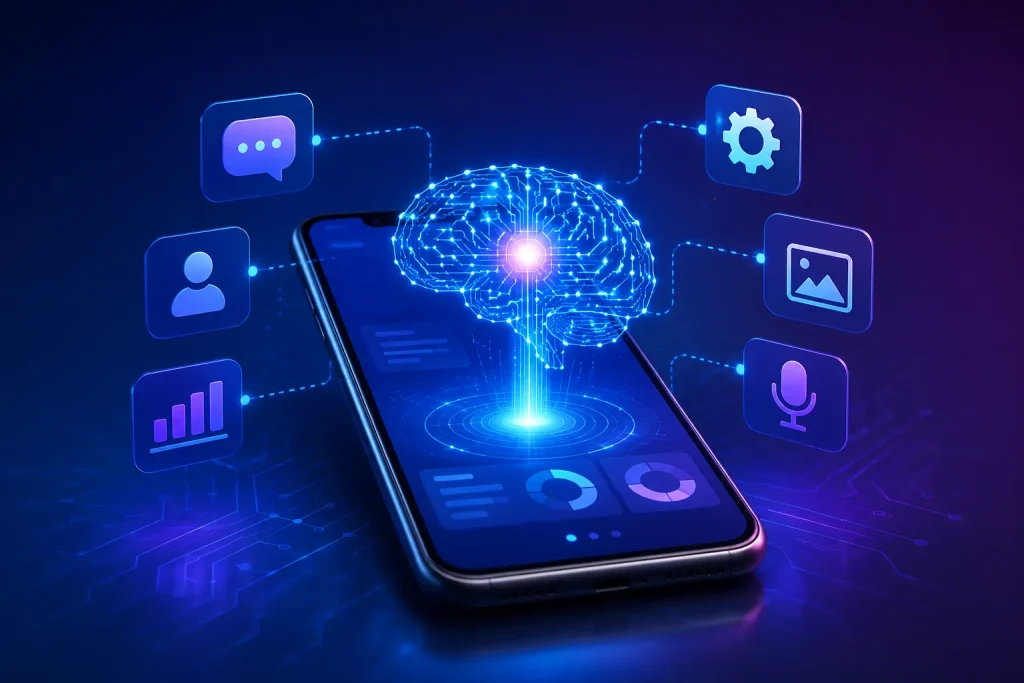
AI assistants can allow users to communicate with an application using natural language instead of navigating complicated menus. They can answer questions, explain products, provide recommendations, summarize information, and guide users through workflows.
AI-Powered Conversational Assistants
AI can analyze user interactions, preferences, searches, purchases, content consumption, and other permitted signals to deliver more relevant recommendations.
Personalized Recommendations
Potential applications include document scanning, object recognition, image classification, visual search, product identification, identity verification, quality inspection, and augmented experiences.
Computer Vision and Image Intelligence
AI can convert speech into text, understand user intent, process commands, and generate responses. Voice capabilities can be useful for search, customer service, productivity applications, accessibility, navigation, and hands-free workflows.
Voice Recognition and Natural Language Processing
Businesses can use predictive models for demand forecasting, customer churn analysis, inventory planning, fraud detection, engagement prediction, maintenance alerts, and personalized recommendations.
Predictive Analytics
For example, a travel application could help a customer compare available options, organize preferences, and prepare a travel plan. A business application could summarize incoming requests, classify them, and route them to the correct workflow.
Intelligent Automation and AI Agents
6 High-Value AI Capabilities for Mobile Applications
How to Successfully Integrate AI in Mobile App Architecture
The most effective way to integrate AI in mobile app development is to begin with the product requirement rather than selecting an AI model first.
Start by identifying a specific user problem. Determine whether AI can solve it better than conventional application logic. If a simple rule, search function, or database query can solve the problem reliably, adding an AI model may introduce unnecessary cost and complexity.
Mobile Application → Secure Backend/API → AI Service or Model → Business Data → Response → Mobile UI
The mobile application should generally avoid exposing sensitive credentials or unrestricted AI service keys directly inside the client. A secure backend can manage authentication, authorization, rate limits, logging, business rules, model requests, and data filtering.

Best Practices for Building Reliable AI-Powered Mobile Apps
AI should solve a meaningful user or operational problem rather than exist simply because it is trending. Define the expected outcome, user benefit, measurable KPI, and reason conventional software is insufficient.
Start With a Real Business Problem
AI applications can process sensitive customer information, conversations, images, documents, and behavioral data. Use encryption, access controls, secure APIs, data minimization, and appropriate retention policies throughout the architecture.
Protect User Data
AI responses can sometimes be incomplete, incorrect, ambiguous, or inconsistent. Build validation, confidence thresholds, fallback workflows, human review, and clear user feedback mechanisms where accuracy matters.
Design for AI Uncertainty
Mobile users expect fast interfaces. AI features should not block critical screens unnecessarily. Use asynchronous processing, caching, streaming where appropriate, efficient models, background operations, and graceful fallback states.
Optimize Mobile Performance
AI costs can increase quickly when applications process large volumes of requests. Optimize prompts, model selection, caching, request frequency, token usage, image processing, and backend architecture before scaling to large user volumes.
Control AI Infrastructure Costs
Launching an AI feature is not the end of development. Monitor response quality, latency, errors, usage, user feedback, infrastructure costs, and business outcomes.
Continuously Monitor and Improve
Frequently Asked Questions?
Yes. Businesses can integrate AI into existing Android or iOS applications without necessarily rebuilding the entire product.
The cost varies significantly depending on the AI feature, model, data requirements, mobile platforms, backend architecture, API usage, security requirements, and development complexity.
Mobile applications can use technologies including generative AI, natural language processing, machine learning, computer vision, speech recognition, recommendation engines, predictive analytics, intelligent search, and AI agents.
Let's Connect
Ready to Start Your Project?
Let’s discuss how we can help bring your vision to life with our expertise.