
Grow. Nourish. Thrive.
Organic Food E-commerce Website Development for Modern Food Brands
At Amunis Technologies, we create custom e-commerce websites with intuitive shopping experiences, organized product categories, secure checkout functionality, and flexible management features. Our goal is to help your business present its products clearly, build customer confidence, and create a convenient online shopping journey that supports long-term growth.
Selling organic food online requires more than attractive product photographs and an add-to-cart button. Customers often want to understand ingredients, product origins, storage requirements, packaging, certifications where applicable, and delivery conditions before placing an order. An Organic Food E-commerce Website can bring these details together in a clear, accessible shopping environment.
Our solutions can include product catalogue management, weight and pack-size variations, inventory controls, payment integrations, delivery-zone configuration, customer accounts, discount management, and order tracking. We also consider how your team will update product information, manage changing stock levels, publish educational content, and handle customer enquiries after launch. Whether you are introducing your first online store or upgrading an existing website, we focus on practical functionality, mobile usability, maintainable development, and search-friendly architecture.
Organic Food E-commerce Website Solutions for Growing Food Businesses
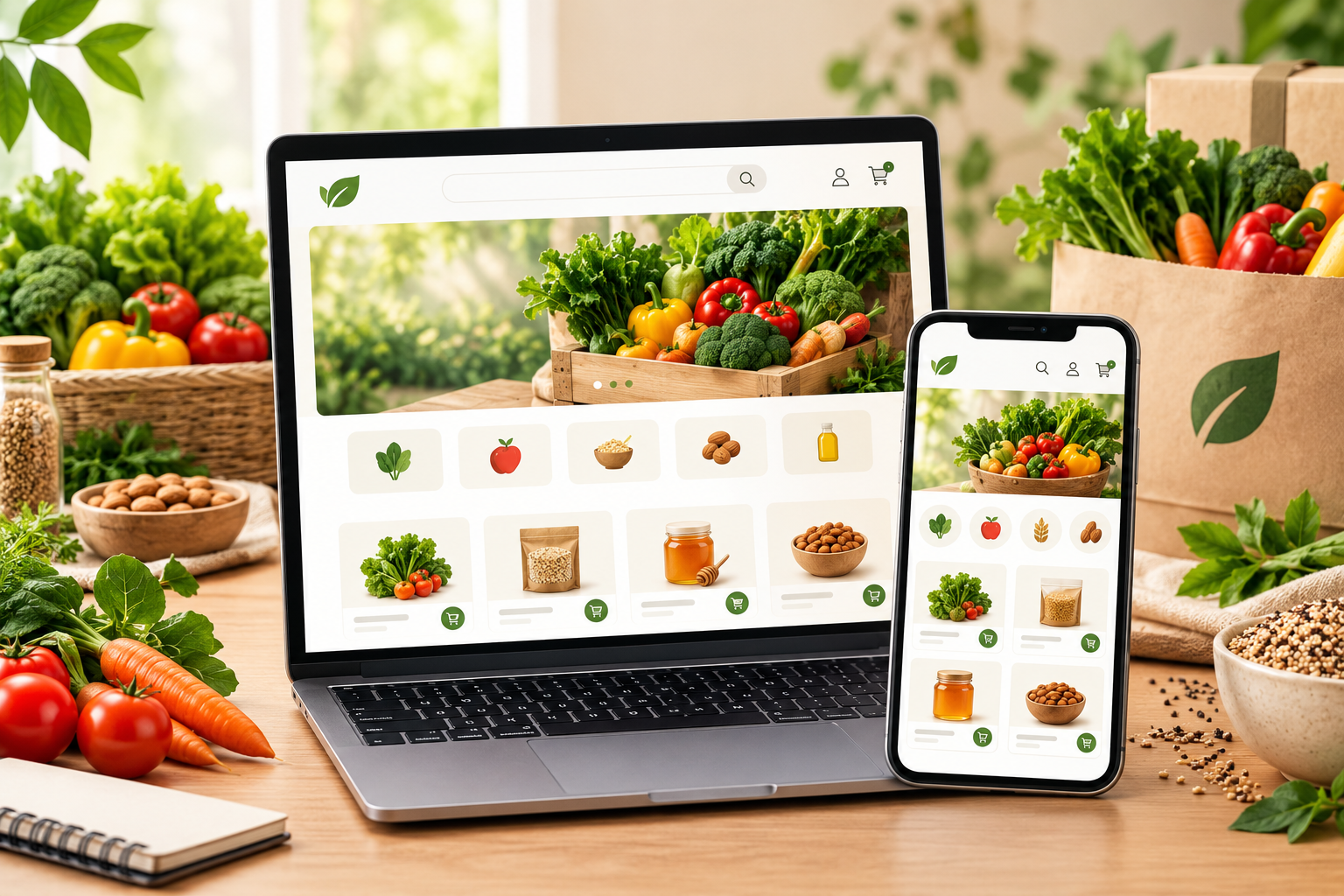
Arrange fruits, vegetables, grains, pulses, spices, oils, snacks, and other products into intuitive categories. Clear navigation and relevant filters help shoppers discover suitable products without unnecessary browsing.
Organized Organic Product Categories
Display ingredients, pack sizes, nutritional information where applicable, storage instructions, sourcing details, and verified certification information. Accurate product descriptions help customers understand their purchases before completing checkout.
Detailed Product Information and Transparency
Track stock levels, product variations, and availability through an organized administration panel. Suitable stock alerts and inventory updates help teams manage replenishment and reduce orders for unavailable products.
Smart Inventory and Availability Management
Provide a straightforward checkout with clear pricing, delivery charges, supported payment methods, and order summaries. A simple purchasing journey helps customers review their selections and complete transactions confidently.
Convenient Shopping Cart and Secure Checkout
Configure delivery areas, shipping methods, dispatch updates, and available delivery windows where supported. Clear delivery information helps customers understand fulfilment expectations and helps staff coordinate orders more efficiently.
Fresh Food Delivery and Order Tracking
Build responsive layouts that work across smartphones, tablets, and desktops. Search-friendly URLs, descriptive page titles, optimized images, and structured product information support usability and help search engines understand your catalogue.
Mobile-Friendly Design and Search Visibility
Six Essential Features of an Organic Food E-commerce Website
Custom Organic Food E-commerce Website Development Built for Your Business
Every organic food business has different products, fulfilment requirements, and customer expectations. A farm selling seasonal produce may need availability updates and scheduled delivery options, while a packaged food brand may prioritize product variants, bulk ordering, subscription purchases, and promotional bundles. A natural grocery retailer with hundreds of products may need advanced search, category filters, and streamlined inventory management.
We also consider the details that influence customer confidence and operational reliability. Product pages should communicate relevant information without overwhelming visitors, prices and pack sizes should be easy to understand, and delivery conditions should be visible before customers pay. Where products require batch information, expiry tracking, seasonal availability, or special storage instructions, the implementation should support the relevant business rules. Payment and shipping integrations must be tested against the providers’ technical requirements, while forms and checkout fields should validate submitted information appropriately.

Advanced Capabilities for a More Effective Organic Food Store
Offer recurring orders for eligible grocery products, weekly produce boxes, or monthly pantry essentials. Subscription functionality can simplify repeat purchasing when supported by suitable billing, fulfilment, and inventory workflows.
Subscription Orders and Repeat Purchasing
Create curated food boxes, combination offers, festival collections, and seasonal product groups. Flexible merchandising helps customers discover complementary products while giving your team more control over promotional campaigns.
Product Bundles and Seasonal Collections
Allow customers to review previous orders, manage saved addresses, track purchases, and reorder eligible products. Convenient account features reduce repetitive shopping tasks and support a smoother experience for returning customers.
Customer Accounts and Purchase History
Connect supported payment providers, shipping services, and order notification systems. Integration planning should account for transaction verification, delivery coverage, service availability, failed requests, and the business rules needed for reliable fulfilment.
Payment and Shipping Integrations
Publish recipes, ingredient guides, storage advice, and educational articles related to your product range. Useful content supports product discovery, answers customer questions, and creates additional opportunities for relevant search traffic.
Organic Food Content and Recipe Publishing
Monitor orders, product performance, traffic sources, cart activity, and other relevant indicators. Analytics help your team identify purchasing patterns, evaluate campaigns, and prioritize improvements using observed customer behaviour.
Analytics and Store Performance Monitoring
Frequently Asked Questions?
Essential features usually include intuitive product categories, search and filtering, informative product pages, pack-size variations, stock management, secure checkout, delivery information, and order notifications. Depending on the business, additional functionality may include subscriptions, product bundles, customer reviews, loyalty programmes, recipe articles, and advanced inventory controls. The best feature set depends on your catalogue size and how orders are processed.
Yes. A suitable subscription solution can allow customers to select recurring orders for eligible products or curated food boxes. Depending on the implementation, it may support delivery frequency, subscription changes, renewal reminders, and recurring payments.
The cost depends on the number of products, design complexity, chosen platform, payment and shipping integrations, inventory requirements, subscription features, and custom functionality. A small store with a standard catalogue requires a different scope from a large grocery platform with complex fulfilment workflows.
Let's Connect
Ready to Start Your Project?
Let’s discuss how we can help bring your vision to life with our expertise.