
Imagine. Simulate. Play.
Simulation Games Development for Immersive Interactive Experiences
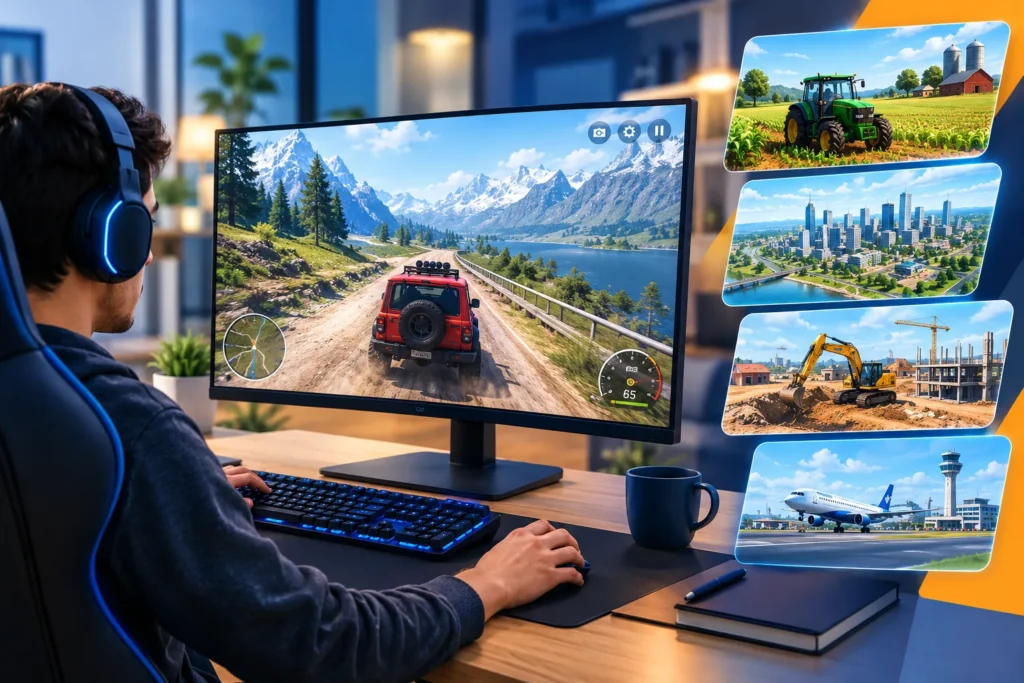
Simulation Games Development transforms creative concepts into interactive applications where players can operate vehicles, build virtual cities, manage businesses, explore realistic environments, or experience everyday activities through gameplay.
Simulation games give players the freedom to explore systems, make decisions, and experience the consequences of their actions inside a virtual environment. Whether someone is driving through a detailed city, operating heavy machinery, managing a farm, designing a business, or building an entire community, the experience depends on how naturally the game responds to player input. Successful development requires more than attractive graphics; gameplay logic, responsive controls, balanced progression, and consistent performance must work together to create an experience players want to revisit.
. We can help define the core gameplay concept, plan user journeys, develop game mechanics, design interfaces, create suitable environments, and implement features according to the project scope. Depending on the requirements, a simulation game may include 2D or 3D graphics, character movement, vehicle controls, resource management, artificial intelligence, achievements, player profiles, or online functionality.
Simulation Games Development That Turns Ideas Into Playable Worlds
We develop responsive movement, interactions, object behavior, and physics-based mechanics suited to your game concept, balancing realism with enjoyable gameplay and the capabilities of target devices.
Realistic Gameplay Mechanics
Create virtual cities, farms, roads, interiors, industrial spaces, and open environments with meaningful interactive elements. Environment design supports immersion while keeping navigation and important gameplay objectives clear.
Interactive 2D and 3D Environments
Implement touch, keyboard, controller, or other supported input systems for driving, walking, operating equipment, and interacting with objects. Control responsiveness is tuned through iterative playtesting.
Vehicle and Character Control Systems
Develop non-player character routines, traffic behavior, resource responses, and environmental events where appropriate. Defined behavior rules help virtual worlds feel active without introducing unpredictable or unfair gameplay.
Intelligent NPC and Environment Behavior
Build missions, unlockable content, achievements, upgrade systems, and difficulty progression around player goals. A well-paced progression system gives players meaningful reasons to continue exploring and improving.
Progression, Rewards, and Challenges
Prepare simulation applications for agreed target platforms, such as Android, iOS, PC, or supported web environments. Device testing and performance optimization help maintain responsive controls and stable gameplay.
Mobile and Cross-Platform Optimization
Six Essential Elements of Engaging Simulation Game Applications
From Game Concept to a Fully Playable Simulation Experience
A strong simulation game starts with a clear definition of what the player should experience. A driving simulator may depend on vehicle handling, road design, traffic patterns, and camera behavior. A farming game may rely on crop cycles, equipment upgrades, weather, and resource planning. A city-building simulator may require interconnected systems for construction, population, finances, and infrastructure. Identifying the core gameplay loop early helps prevent unnecessary features from complicating the initial development process.
Our Simulation Games Development process begins with your concept, target audience, preferred platform, visual direction, and essential gameplay requirements. We translate these inputs into a practical scope covering mechanics, screens, environments, technical architecture, and milestone deliverables. Where appropriate, an early prototype can be used to evaluate controls, gameplay balance, and technical feasibility before expanding into full production.

Advanced Simulation Game Features for Deeper Player Engagement
Introduce changing weather, lighting, day-and-night cycles, and environmental conditions where they support gameplay. These systems can influence visibility, atmosphere, challenges, and the player’s decisions within the virtual world.
Dynamic Weather and Environmental Systems
Create systems for virtual currency, resource collection, inventory, construction costs, upgrades, and in-game trading. Carefully balanced rules make player decisions meaningful and support long-term progression.
Economy and Resource Management
Build structured missions, sandbox challenges, timed objectives, and branching scenarios. Different objectives give players varied activities while allowing the game to accommodate beginners and experienced players.
Missions, Objectives, and Scenario Design
Add suitable online features such as shared environments, cooperative objectives, player interactions, and synchronized game states. Multiplayer scope depends on server architecture, networking requirements, supported platforms, and expected concurrent users.
Multiplayer and Shared Virtual Experiences
Implement player settings, achievements, unlocked content, and saved progress using suitable local or cloud-based storage. Reliable save and recovery behavior helps players continue their experience across sessions and supported devices.
Player Profiles and Progress Saving
Use appropriate gameplay analytics, crash monitoring, feedback collection, and controlled content updates to understand how players interact with the application. These insights can guide future improvements without compromising user privacy.
Analytics, Updates, and Post-Launch Improvements
Frequently Asked Questions?
Yes. Mobile simulation applications can be developed for Android, iOS, or both, depending on the requirements. The interface, controls, graphics, memory usage, and performance should be optimized for the selected devices.
Technology selection depends on the game’s visual complexity, physics requirements, platform targets, and performance goals. Unity and Unreal Engine are common options for 2D and 3D games, while other technologies may suit lightweight or browser-based experiences.
Yes. A project can include vehicle handling, acceleration, braking, steering, collision behavior, object interaction, and other physics-based mechanics. The appropriate level of realism depends on the gameplay goals and the target hardware.
Let's Connect
Ready to Start Your Project?
Let’s discuss how we can help bring your vision to life with our expertise.