
Care. Coordinate. Improve.
Healthcare Admin Dashboard Development for Smarter Healthcare Operations
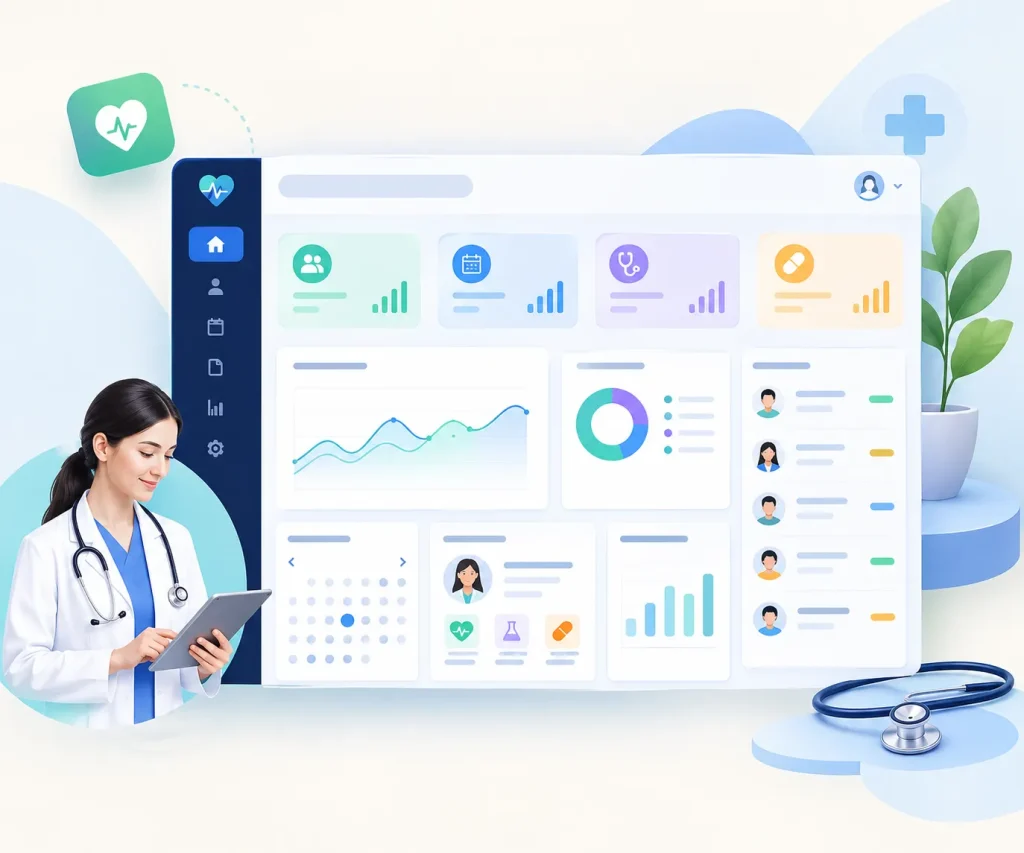
We build custom healthcare administration dashboards designed around your organization’s requirements, helping teams manage everyday processes, access relevant information, and coordinate administrative responsibilities through a clear, structured interface.
Healthcare organizations coordinate multiple activities every day, from patient registration and appointment scheduling to staff allocation, billing administration, and medical record management. When these activities are handled through disconnected applications or manual processes, teams may spend unnecessary time locating information, updating records, and coordinating routine tasks. Healthcare Admin Dashboard Development brings essential administrative functions into one organized workspace, giving authorized staff a more consistent way to manage operational information.
At Amunis Technologies, we develop custom healthcare administration dashboards for hospitals, clinics, diagnostic centres, telehealth platforms, and healthcare service providers. Depending on the project scope, the dashboard can include patient registration, doctor profiles, appointment calendars, staff management, billing summaries, reporting tools, and integrations with existing healthcare systems. Each module is planned according to the organization’s workflow rather than added simply to make the dashboard look feature-rich.
Healthcare Admin Dashboard Development for Connected Medical Operations
Organize patient registration details, contact information, appointment histories, and relevant administrative records through structured interfaces. Search and filtering tools help authorized staff locate information efficiently while maintaining appropriate access restrictions.
Patient Registration and Profile Management
Manage appointment requests, doctor availability, rescheduling, cancellations, and daily schedules through a centralized calendar. Availability checks and booking-conflict prevention help teams coordinate consultations more consistently.
Appointment Scheduling and Calendar Control
Maintain professional profiles, departmental assignments, staff availability, and administrative schedules. Role-specific views help administrators coordinate resources while allowing healthcare professionals to access functions relevant to their responsibilities.
Doctor and Healthcare Staff Management
Provide controlled access to supported medical documents, reports, prescriptions, and visit-related information where required. Structured record organization and appropriate permissions help teams retrieve relevant information without exposing sensitive data unnecessarily.
Medical Records and Document Organization
Organize billing records, invoice statuses, payment summaries, and operational reports according to the agreed requirements. Reporting filters help administrators review activity, identify incomplete administrative tasks, and monitor selected performance indicators.
Billing and Administrative Reporting
Define permissions for administrators, doctors, nurses, receptionists, and other authorized users. Server-side authorization, access logs, and appropriate security controls help protect sensitive information and support administrative accountability.
Role-Based Access and Audit Tracking
Six Essential Features of a Healthcare Administration Dashboard
Custom Healthcare Admin Dashboard Development Built Around Your Facility
Different healthcare organizations need different administrative workflows. A small clinic may prioritize patient registration, appointment calendars, doctor availability, and billing records. A hospital may require department management, staff coordination, admissions, discharge administration, inventory visibility, and more extensive reporting. A telehealth platform may need virtual appointment coordination, provider onboarding, consultation status management, and integrations with communication services. A successful dashboard should reflect these differences instead of forcing every organization into a generic interface.
Our development process starts by understanding your operational requirements, user roles, existing software, and information flows. We then plan the dashboard structure, identify the necessary modules, define data relationships, and establish integration requirements. Based on the project scope, our team can develop custom interfaces, backend functionality, database connections, reporting tools, APIs, and administrative workflows that support the intended use of the system.
Advanced Healthcare Dashboard Capabilities for Better Coordination
Configure appointment reminders, pending-task alerts, schedule updates, and administrative notifications based on approved workflows. Clear notification rules help teams stay informed while reducing unnecessary manual follow-ups.
Automated Reminders and Administrative Notifications
Organize departments, service locations, staff assignments, and operational summaries within a suitable dashboard structure. Centralized oversight can help healthcare groups coordinate activities across facilities while preserving location-specific permissions.
Multi-Department and Multi-Location Management
Create reports for appointment utilization, cancellations, administrative workload, service activity, and other defined indicators. Clear visualizations help managers understand operational patterns without presenting analytics as a substitute for clinical judgment.
Healthcare Analytics and Operational Insights
Connect compatible scheduling platforms, electronic health record systems, laboratory systems, billing applications, or communication services where supported. Integration design should prioritize accurate data exchange, appropriate permissions, and dependable error handling.
Healthcare System and API Integrations
Track selected medical supplies, stock quantities, supplier records, and replenishment activities when inventory management is within scope. Configurable alerts can help authorized teams identify low-stock items and organize purchasing workflows.
Inventory and Medical Supply Administration
Build modular functionality that can accommodate additional departments, user roles, reports, and integrations as requirements change. Testing, monitoring, backup planning, and maintenance help support long-term reliability and controlled system improvements.
Scalable Architecture and Technical Maintenance
Frequently Asked Questions?
Common features include patient administration, appointment scheduling, doctor and staff management, reporting, user permissions, and administrative notifications. Medical documents, billing, inventory, department management, and integrations can be added when required by the project.
Yes. We can assess an existing website or application to determine whether a dashboard can be integrated with its current architecture or should be developed as a separate application. The approach depends on available APIs, database access, authentication, and security requirements.
The implementation can incorporate secure authentication, server-side authorization, least-privilege access, encrypted communication, audit logs, and suitable data protection measures. The final safeguards must be selected according to the information being processed, applicable regulations, and the system’s risk assessment.
Let's Connect
Ready to Start Your Project?
Let’s discuss how we can help bring your vision to life with our expertise.