
Investigate. Solve. Win.
Build Immersive Crime Investigation Games That Keep Players Thinking
Crime Scene Games Development requires more than creating a dark environment and placing evidence around a room. The experience depends on how effectively the game makes players observe, interpret, question, connect, and make decisions.
A successful investigation game can begin with a seemingly ordinary location and gradually reveal layers of information. Players may examine objects, compare statements, identify inconsistencies, review documents, inspect digital evidence, reconstruct events, and determine which clues are meaningful. Our development process focuses on connecting these interactions into a coherent gameplay loop instead of presenting disconnected puzzles.
We develop custom crime investigation and detective games with engaging narratives, realistic environments, evidence systems, branching conversations, puzzles, character interactions, and progression mechanics. From an initial crime concept to a playable cross-platform product, our development approach combines game design, programming, visual storytelling, UI/UX, animation, audio, optimization, and testing into one structured production workflow.
Crime Scene Games Development
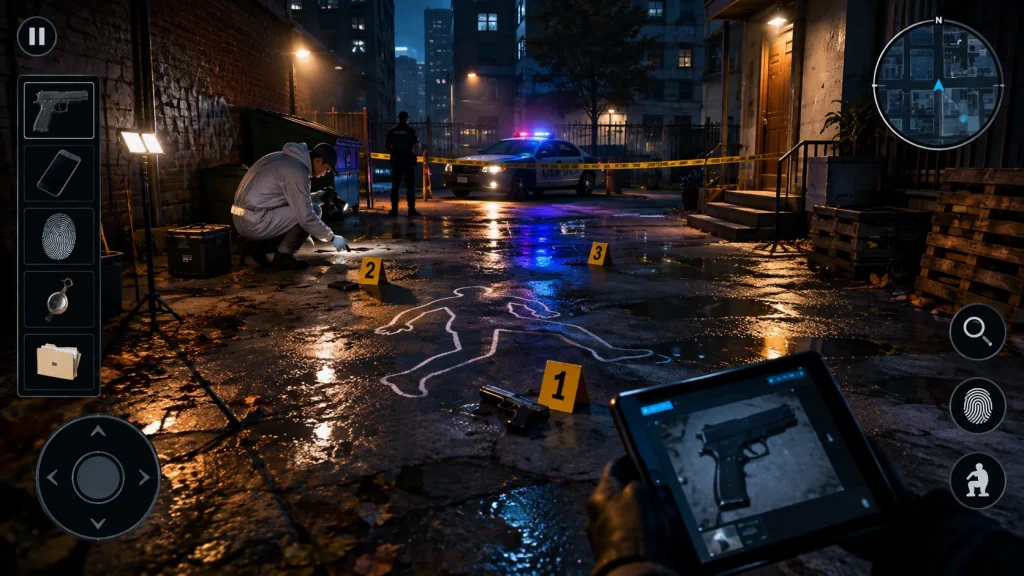
Players can freely inspect locations, examine objects, discover hidden evidence, and interact with environmental details. Carefully designed interactions transform static environments into meaningful investigation spaces.
Interactive Crime Scene Investigation
Create structured evidence systems where players collect photographs, documents, fingerprints, objects, recordings, messages, and other clues. Evidence can be categorized and connected throughout each investigation.
Evidence Collection & Analysis
Develop dialogue-driven interactions that allow players to question suspects, compare statements, uncover contradictions, and unlock additional information based on previous investigation choices and discovered evidence.
Suspect Interrogation
Design multiple investigation paths where player decisions affect conversations, clue discovery, objectives, character relationships, and potential conclusions, creating greater replayability and meaningful player involvement.
Branching Mystery Narratives
Introduce logical challenges requiring players to reconstruct timelines, match evidence, decode information, identify inconsistencies, connect suspects, or determine how individual clues relate to the central mystery.
Detective Puzzles & Deduction
Build structured progression through case files, objectives, evidence boards, investigation journals, rankings, achievements, unlockable locations, new suspects, and increasingly complex cases as players advance.
Investigation Progression System
Essential Features for Crime Scene Games Development
From Crime Concept to Complete Interactive Investigation
Our Crime Scene Games Development process begins by transforming your basic game concept into a structured gameplay experience. We first define the investigation premise, target platform, player role, game perspective, core gameplay loop, case structure, characters, evidence types, puzzles, progression, and desired visual direction.
The development phase then converts those concepts into functional game systems. Environments are created around investigation opportunities rather than decoration alone. Interactive objects are connected to gameplay logic, evidence is linked to case progression, dialogue systems respond to player actions, and clues are structured so that solving a case requires observation and reasoning. For 3D projects, the production pipeline can include environment creation, meshes, lighting, visual effects, character animation, input controls, and UI systems. Unity’s current development documentation identifies these as core parts of its 3D workflow.

Choose a Professional Crime Game Development Approach
A strong mystery needs a logical sequence of events, believable motives, meaningful clues, and controlled information delivery. We structure gameplay around the investigation rather than adding story elements after development.
Story-First Game Design
Crime scenes can include apartments, offices, streets, warehouses, hotels, abandoned buildings, laboratories, or fictional locations. Environments are designed to support exploration, atmosphere, clues, and gameplay.
Immersive Environment Design
Player actions can influence available information, objectives, dialogue, evidence, and progression. Interactive systems help the investigation feel dynamic instead of following a completely fixed sequence.
Responsive Gameplay Systems
Depending on project requirements, games can be planned for mobile, PC, web, or other supported platforms. Platform-specific controls, UI layouts, performance targets, and technical requirements are considered during production.
Cross-Platform Development
A well-structured case system makes it possible to expand a game with additional investigations, locations, suspects, evidence, missions, puzzles, and narrative chapters without rebuilding the entire product.
Scalable Case Architecture
Investigation games require extensive testing because unclear clues can make cases frustrating while overly obvious evidence can remove the challenge. Testing helps balance difficulty, progression, usability, performance, and player understanding.
Testing & Gameplay Balancing
Frequently Asked Questions?
We can develop detective adventures, crime investigation games, mystery puzzle games, evidence-analysis games, narrative investigation games, hidden-object experiences, interrogation-focused games, simulation-style investigations, and hybrid gameplay formats.
AI-related functionality can be incorporated where technically appropriate. Possible applications include dynamic dialogue, character behavior, procedural case generation, clue assistance, conversational systems, adaptive difficulty, or content-generation workflows. Each feature should be evaluated according to gameplay requirements, cost, latency, privacy, and platform constraints.
Yes. Android-focused investigation games can be developed with touch-friendly controls, responsive interfaces, optimized environments, efficient assets, appropriate performance targets, and mobile-oriented gameplay sessions. Android provides dedicated resources for game development and optimization.
Let's Connect
Ready to Start Your Project?
Let’s discuss how we can help bring your vision to life with our expertise.