
Think. Act. Assist.
AI Personal Assistant App Development Build Smarter Digital Assistants
AI Personal Assistant App Development is transforming ordinary mobile applications into intelligent digital companions that can understand conversations, remember preferences, organize tasks, automate workflows, and help users make faster decisions.
An AI personal assistant app is an intelligent software application designed to understand natural human communication and help users complete tasks, retrieve information, organize activities, and interact with connected digital services. Unlike traditional applications that require users to navigate multiple menus, an AI assistant can provide a conversational interface where users simply describe what they need.
For example, instead of opening a calendar, searching for a free time slot, creating an event, and sending invitations separately, a user could tell the assistant, “Find a suitable time for my meeting tomorrow and prepare an invitation.” The assistant can interpret the request, check connected information, identify the required actions, and guide the user through the final process.
What Is an AI Personal Assistant App?
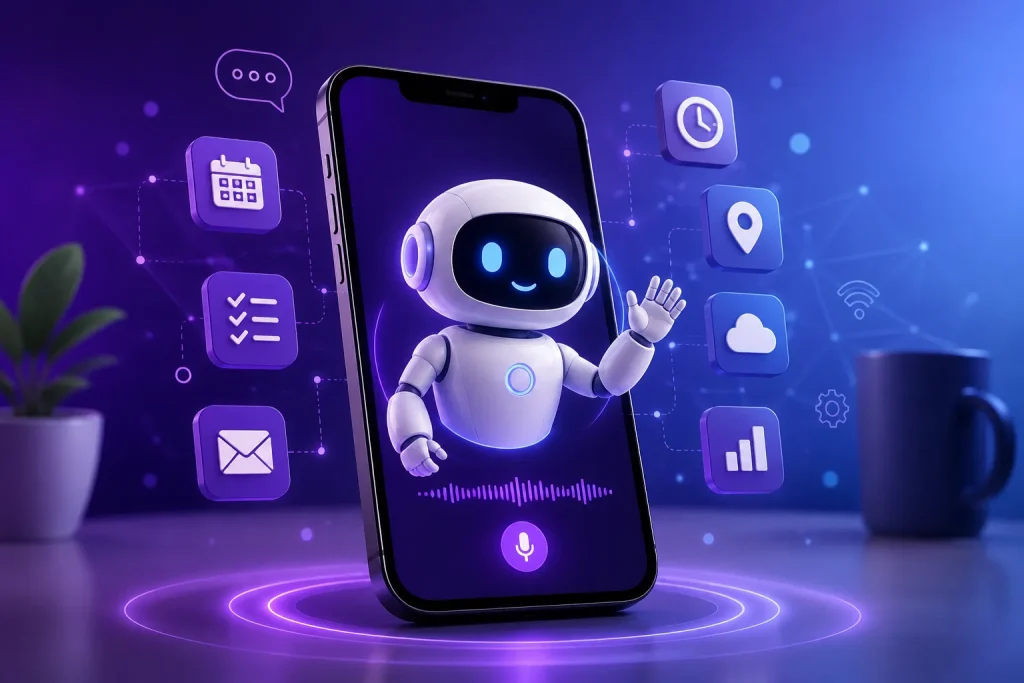
The assistant should understand conversational requests rather than relying on rigid commands. It can interpret intent, identify important information, understand variations in wording, and respond naturally to users across different scenarios.
Natural Language Understanding
AI memory allows an assistant to retain relevant preferences and context with appropriate user controls. This can make interactions more personalized while reducing the need for users to repeatedly provide the same information.
Personalized AI Memory
Voice functionality enables users to communicate naturally while driving, working, exercising, or performing other activities. Speech-to-text, text-to-speech, interruption handling, and low-latency processing create a more natural assistant experience.
Voice-Based Interaction
The assistant can convert conversational requests into actions such as creating tasks, organizing schedules, generating reports, sending approved communications, or triggering connected workflows.
Smart Task Automation
Calendar systems, email platforms, payment services, maps, CRM systems, communication tools, cloud storage, and other APIs can expand what the assistant is capable of doing.
Third-Party Integrations
A sophisticated assistant can use relevant context to provide more useful recommendations. Instead of simply answering questions, it can help users compare options, prioritize activities, identify patterns, and make informed decisions.
Context-Aware Recommendations
Essential Capabilities of a Modern AI Personal Assistant
How We Approach AI Personal Assistant App Development
Building an AI assistant successfully requires more than selecting an AI model and creating a chat interface. The architecture must account for conversations, actions, permissions, data, integrations, reliability, security, and future scalability. Our AI Personal Assistant App Development process starts by defining the assistant’s primary job. Instead of attempting to create an assistant that does everything from the first release, we identify the highest-value workflows and build the initial product around them.
This stage helps determine whether the application should prioritize productivity, automation, voice interaction, customer support, recommendations, knowledge retrieval, or another specialized capability. Instead of choosing a development budget from a generic online estimate, businesses should define the assistant’s workflows first and then prepare a scope-based development estimate.
Building a Reliable AI Assistant What Matters Beyond Features
Voice-enabled assistants require multiple components working together, including speech recognition, language processing, response generation, and text-to-speech.
Speech and Voice AI
AI responses can vary depending on context and input. Production systems therefore need evaluation processes, fallback strategies, validation rules, and monitoring.
Accuracy and Reliability
For sensitive or irreversible actions, the application can introduce confirmation steps. For example, the assistant may prepare a payment, message, booking, or deletion request and ask the user for confirmation before executing it.
Human Approval
Personal assistants may process calendars, documents, conversations, preferences, location information, or other sensitive data. Security should therefore be considered during architecture planning rather than added after development.
Privacy by Design
AI usage can create recurring operational costs. Every conversation, retrieval operation, voice request, and automated workflow can consume infrastructure or third-party AI resources.
Cost-Aware AI Architecture
Streaming responses, efficient APIs, caching, asynchronous processing, optimized prompts, model selection, and well-designed backend architecture can improve perceived performance.
Fast Response Times
Frequently Asked Questions?
Yes. Voice-enabled assistants can combine speech recognition, natural language processing, AI response generation, and text-to-speech technology to provide conversational voice interactions.
Yes. Developers can implement short-term conversation context and controlled long-term memory. Memory should be designed with privacy, permissions, retention rules, and user controls so that users can understand and manage what the application remembers.
Yes. An AI assistant can integrate with calendars, email systems, CRM platforms, maps, cloud storage, payment services, messaging platforms, business software, and custom APIs depending on technical availability and authorization requirements.
Let's Connect
Ready to Start Your Project?
Let’s discuss how we can help bring your vision to life with our expertise.